A landscape-led transition to a more circular waste system for Ōtepoti Dunedin
23 June 2026
SHARE


Boffa Miskell is working alongside Dunedin City Council and Te Rūnanga o Ōtākou to help deliver the Green Island Landfill Closure and Resource Recovery Park as part of the Dunedin Waste Futures Programme.
Dunedin Waste Futures is designed to support the city’s 2050 carbon reduction objectives by changing both how waste is collected and how it is processed. The programme combines a redesigned kerbside collection system, new local recovery and organics-processing infrastructure, staged closure of Green Island Landfill, and wider behaviour-change and waste-minimisation initiatives into a single coordinated framework. In practical terms, it moves the city away from a linear “collect and bury” model and toward a system in which more materials are separated, recovered, reused, and composted locally.
The whole-of-system approach is the point of difference. Each component depends on the others: kerbside separation only works if there is local infrastructure to process the resulting material streams; recovery infrastructure only delivers value if collection systems are redesigned to feed it; and landfill closure can only be responsibly staged if diversion rates rise and long-term planning is aligned. The innovation of Dunedin Waste Futures lies in that integration, and in the clarity with which the city and its project partners have communicated it.

Since 2018, Boffa Miskell has been embedded within Dunedin City Council’s Waste and Environmental Solutions team, working alongside engineers, planners, mana whenua representatives, and other specialists to help shape the programme from early strategic thinking through to implementation. Over that time, Boffa Miskell has led the landscape architecture, environmental planning, consenting, and engagement workstreams, helping to ensure that technical, regulatory, cultural, and community considerations have been brought together in a coherent way.
This long-term role has been central to the programme’s success. Early phases focused on strategic investigations and business case work to identify the best medium- to long-term waste system for Dunedin. That work established the basis for a circular economy approach: one that could significantly reduce the amount of waste sent to landfill and lower associated carbon emissions over time. Rather than treating waste as an end-of-life issue, the programme rethinks the whole system from collection and separation through to recovery, processing, and residual disposal.
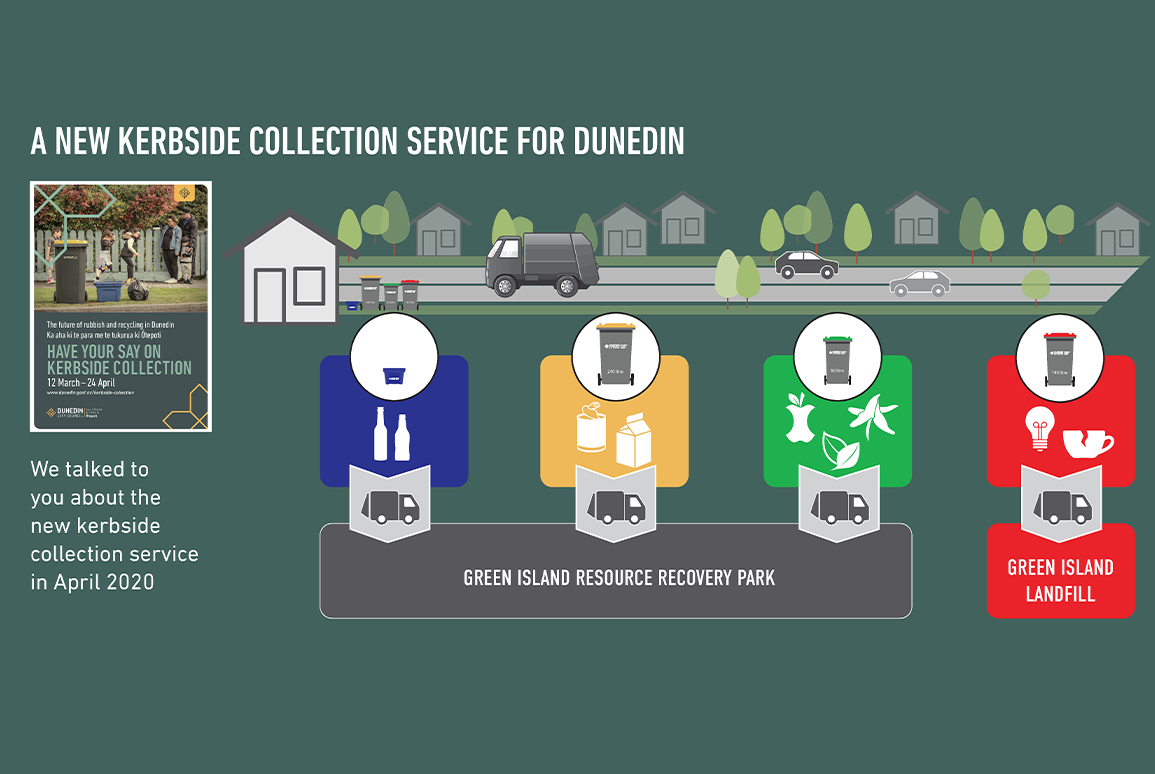
A visible public milestone was the redesign of Dunedin’s kerbside collection service. Community consultation in 2020 showed strong support for introducing food scraps and garden waste collection and replacing rubbish bags with bins. This informed the city’s four-bin kerbside collection system, introduced from July 2024, which now includes dedicated organics and rubbish bins alongside recycling and glass services. By separating more material at source, Dunedin has created the front-end conditions needed for greater diversion from landfill.
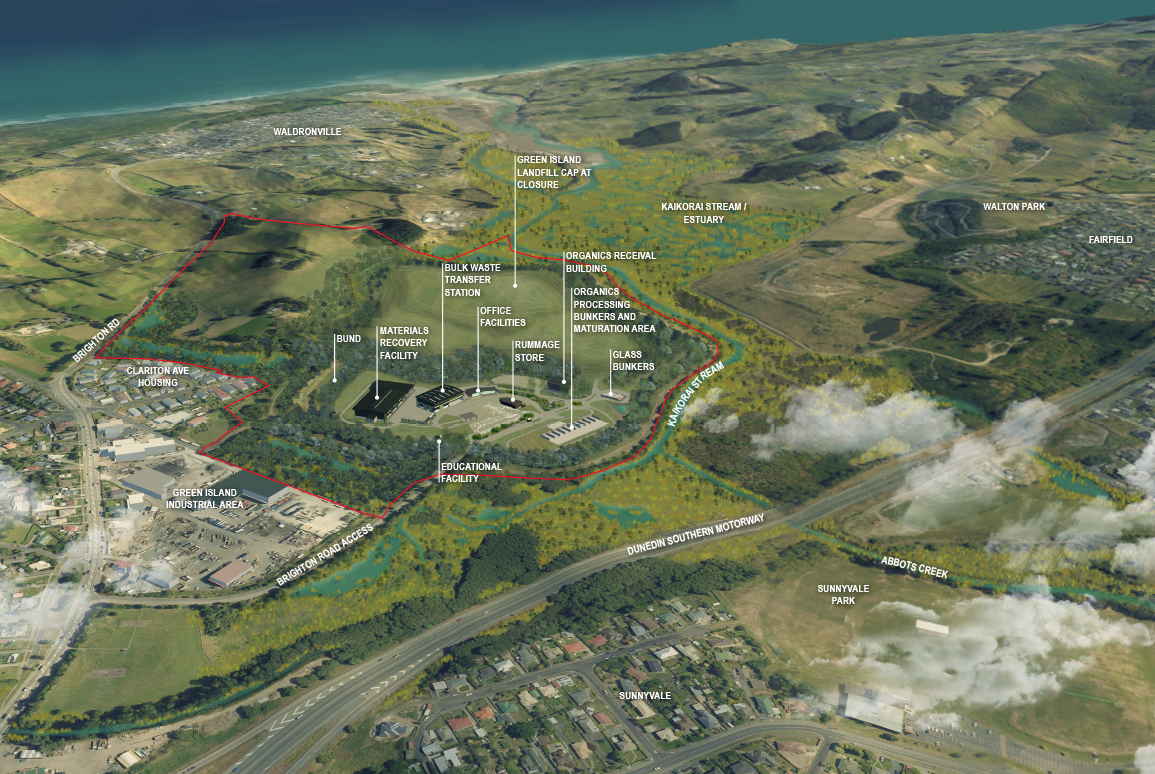
The redevelopment of the Green Island Resource Recovery Park is the critical physical counterpart to those service changes. Designed to support the new collection system, the park includes a Materials Recovery Facility for mixed recycling, infrastructure for organics processing and composting, upgraded glass sorting and storage, a bulk waste transfer station, and supporting operational facilities. Importantly, public-facing functions such as the recycling drop-off area, the Rummage store, and education facilities remain part of the site’s future. Resource consent for the Resource Recovery Park was granted in 2025.
At the same time, the programme addresses the staged closure of Green Island Landfill. Rather than viewing closure as a technical exercise, the project treats it as part of a broader landscape transition. Resource consent for landfill closure had been granted in 2024. Waste continues to be placed within the existing landfill footprint while closure and capping proceed in stages, aligned with the development of recovery infrastructure and the city’s reduced reliance on disposal. This staged approach allows Green Island to evolve over time from an operational landfill into a more restorative landscape shaped by ecological, cultural, and community aspirations.
Boffa Miskell’s contribution has given this transformation a clear landscape framework. Our role includes developing the overarching site strategy, leading consent processes, preparing landscape and visual effects assessments and ecological impact assessments, and translating complex technical information into accessible public narratives and visual tools. Landscape analysis considered the site’s basin landform, estuarine setting, hydrology, visibility, vegetation, and relationship to surrounding residential areas and important landscape features such as Saddle Hill. This evidence-based approach informed decisions about landform, planting, screening, infrastructure placement, and the site’s long-term legibility.

Community engagement has underpinned the entire process. Led by Boffa Miskell, the engagement strategy was designed to be authentic and sustained, rather than a one-off consultation exercise. Over multiple stages, the team worked with neighbours, stakeholders, and the wider Green Island community to explain how the site would change over five, ten, and fifty years, and how different parts of the programme connect. Clear, jargon-free communication has been consistently supported by diagrams, staging plans, oblique illustrations, and portable 3D visualisation tools used on site. This has helped the community understand what was proposed, and why. This has been critical in building trust and social licence for a complex and potentially contentious project.
The programme’s ongoing engagement with Te Rūnanga o Ōtākou, working through Aukaha Mana Taiao is a crucial aspect. This relationship has been embedded throughout the project lifecycle, beginning with early site visits and continuing through design development, cultural impact assessment, consenting, and implementation planning. Cultural input has informed much more than standalone reporting: it has helped shape planting and restoration approaches, the framing of the estuary as a living system with both ecological and cultural significance, and the long-term stewardship aspirations for the site. The project team continues to explore ways cultural narratives and identity-making will be expressed through the site over time.
This programme reflects a broader shift in how infrastructure landscapes can be conceived in Aotearoa New Zealand. At Green Island, landscape architecture has not been limited to mitigation at the end of a design process. Instead, it has been central to strategic framing, technical translation, community understanding, and long-term place-making. The result is a project that repositions waste infrastructure as a civic and environmental investment, grounded in shared stewardship and intergenerational thinking.

