Be Bold: Transport Planning for Resilience in Spatial Plans
28 April 2026
SHARE


Mark Apeldoorn and Cameron Martyn examine current transport planning practice in spatial planning; identify strategic gaps and opportunities; and challenge concepts for transport outcomes in Regional Spatial Plans under the proposed Planning Act.
Why transport matters in spatial planning
Across Aotearoa New Zealand, spatial planning is undergoing the most significant reform in a generation. The Government’s Blueprint for resource management reform makes it clear that the way we plan our towns, cities, and regions must change – not incrementally, but fundamentally. Climate change, infrastructure fragility, affordability constraints, inequity, and increasing disruption demand a planning system that is integrated, future‑focused, and resilient.
Transport sits at the centre of this challenge.
Yet despite its role in shaping land use, economic productivity, access to services, public health, and climate outcomes, transport has too often been treated as a secondary consideration in spatial plans: something to be “aligned later” rather than shaping decisions from the outset. The consequences of this disconnect are increasingly visible: development outpacing infrastructure, fragile networks exposed to climate hazards, constrained funding pathways, and communities left vulnerable to disruption.
This article distils recent Boffa Miskell research and conference work into a practical narrative for spatial planning practitioners, decision makers, and infrastructure leaders. It explores what best practice looks like, how New Zealand is tracking, and what must change if spatial plans are to deliver genuinely resilient futures.
Why transport resilience belongs at the heart of spatial planning
The Government Blueprint explicitly identifies transport as a critical gap in current spatial planning practice, noting its failure to adequately integrate land use planning, infrastructure investment, and funding decisions. Spatial plans are intended to translate long‑term vision into coordinated action, but without transport embedded early, they struggle to move from aspiration to delivery.
Transport networks are not just conduits for movement. They are lifelines that support access to employment, education, healthcare, food supply, and emergency response. When networks are disrupted by flooding, landslides, heat, or seismic events, the impacts cascade quickly through communities and economies. Climate change magnifies this exposure, transforming what were once low‑probability risks into routine stresses.
Best-practice internationally recognises that resilience must be planned into systems, not retrofitted onto assets. This requires a shift from corridor‑by‑corridor thinking to a system‑wide perspective that prioritises people, accessibility, and recovery over individual pieces of infrastructure.
The current state of play in New Zealand
New Zealand’s spatial planning framework is in transition. Draft legislation, emerging Regional Spatial Plans, and the proposed Planning Act signal stronger integration between land use, infrastructure, and climate adaptation. Many regions are making genuine progress, embedding transport themes such as mode shift, corridor protection, emissions reduction, and growth sequencing into their spatial strategies.
However, analysis of recent Regional Spatial Plans case studies reveals material inconsistencies in depth and delivery focus. Transport resilience is often acknowledged, but frequently secondary to growth imperatives. Implementation pathways, monitoring frameworks, and funding alignment remain uneven.
A comparative review of three geographically diverse spatial plans in Hamilton–Waikato, Greater Christchurch, and Queenstown Lakes illustrate this variation. While all three address key transport themes, the weighting placed on resilience, climate adaptation, and system redundancy differs substantially, highlighting the absence of a nationally consistent framework for prioritisation and investment.
What international best practice shows us
Internationally, transport resilience has evolved beyond policy rhetoric into operational frameworks and tools. Drawing on experience from North America, Europe, and Australia, several consistent principles emerge:
- Resilience is embedded across the full planning and investment lifecycle
- Climate adaptation is addressed through scenario modelling and dynamic pathways
- Transport systems are stress‑tested to understand failure points
- Equity and community vulnerability are central to prioritisation
- Investment decisions are transparent, evidence‑based, and measurable
Frameworks such as the US Federal Highway Administration’s vulnerability assessment tools, UNECE stress‑testing methodologies, and Infrastructure Australia’s resilience principles all share a common thread: resilience is treated as a system performance outcome, not an optional add‑on.
Ten dimensions of transport planning for resilience
Boffa Miskell’s research identifies ten dimensions that consistently define best practice across national and international contexts:
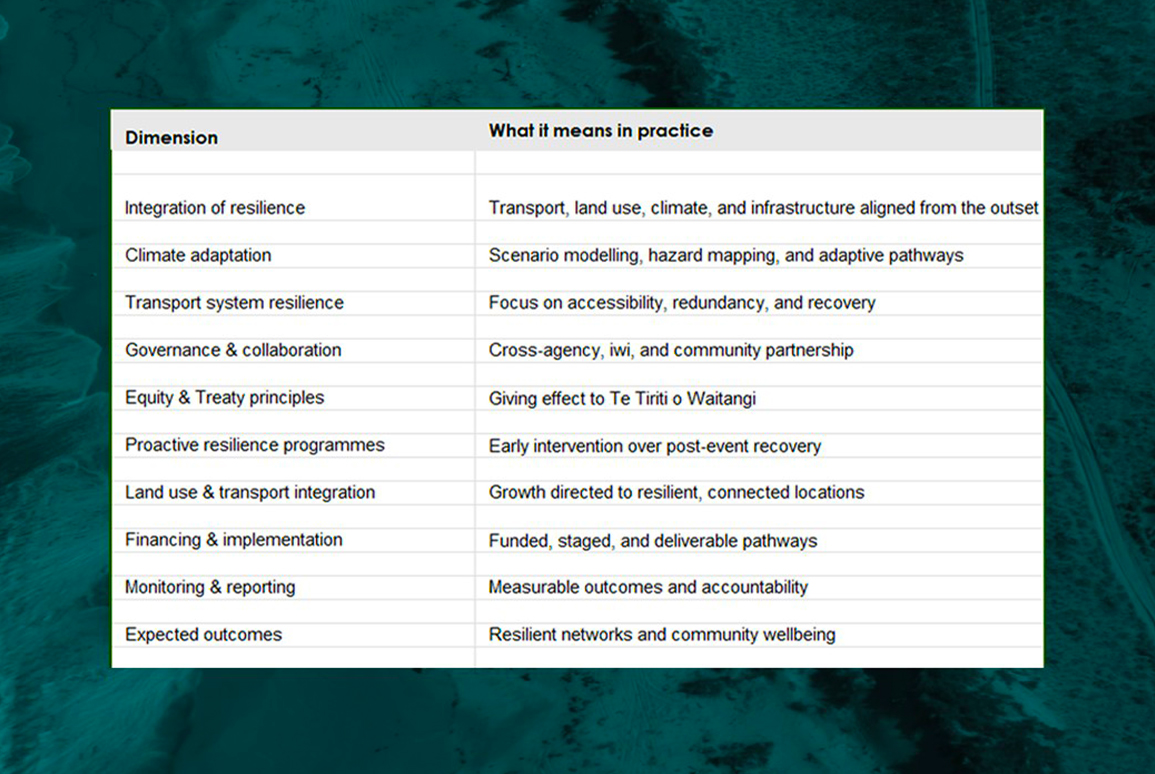
While New Zealand guidance aligns with many of these dimensions in principle, international practice goes further in operationalising them, particularly through stress testing, structured prioritisation, and innovative funding mechanisms.
The Planning Bill: progress, gaps, and opportunity
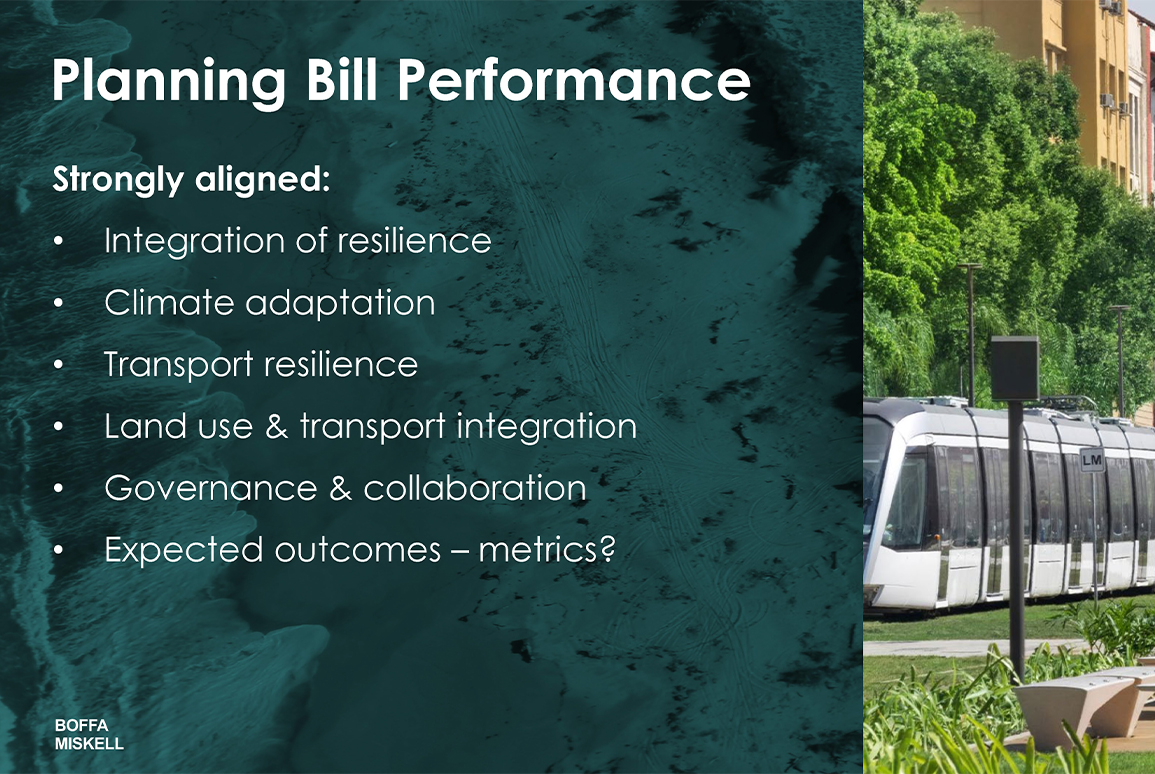
Assessment of the proposed Planning Bill against these ten dimensions shows encouraging alignment in several areas. Integration, climate adaptation, transport resilience, land use coordination, and governance are all strongly reflected in the draft framework.
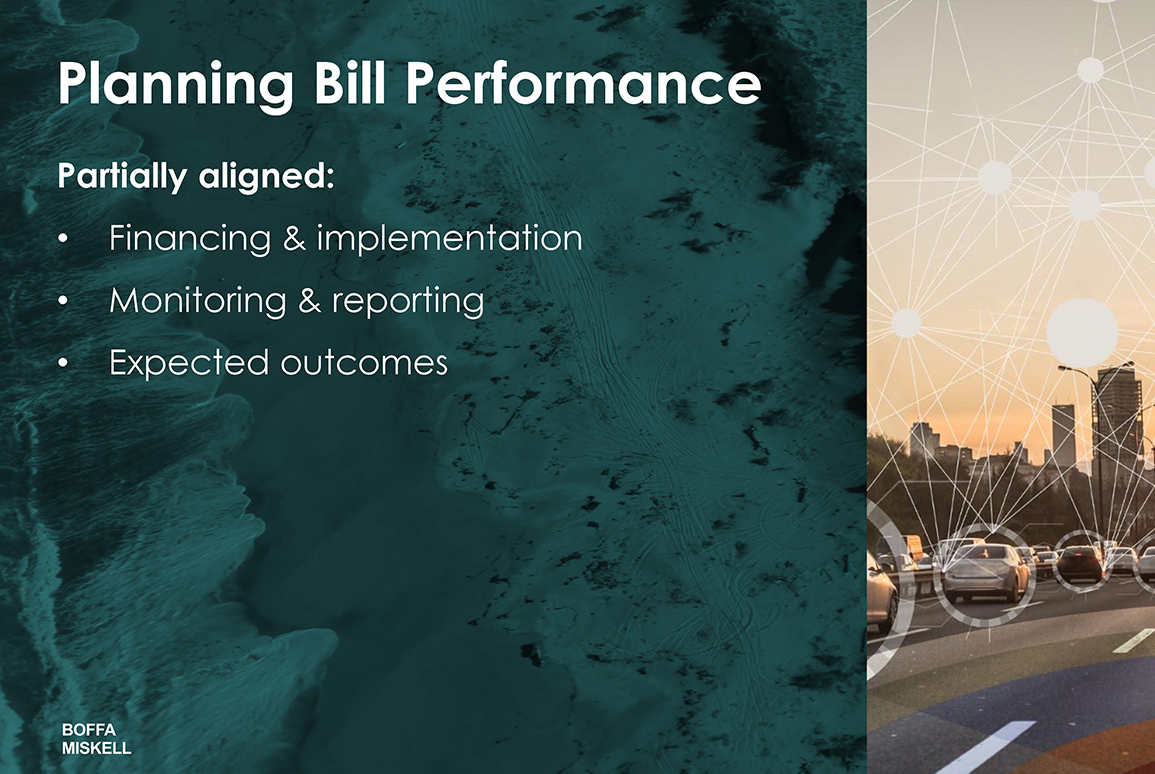
However, implementation‑critical dimensions remain weak or partial, notably in relation to financing, monitoring, and performance metrics.
Without clear mechanisms to prioritise, fund, and track resilience outcomes, spatial plans risk becoming high‑level strategies disconnected from delivery reality. This is where lessons from international practice and the opportunity of reform become pivotal.
Why a National Spatial Plan matters for transport
One of the clearest conclusions of the research is the case for a National Spatial Plan with transport as a core strategic layer.
Currently, transport planning is fragmented across agencies, funding cycles, and statutory instruments. There is no single national spatial reference point to align freight corridors, climate risk, growth directions, and mode shift at scale.
A National Spatial Plan would:
- Provide spatial coherence across national, regional, and local decisions
- Support nationally consistent climate risk and resilience mapping
- Enable strategic freight, port, and airport integration
- Strengthen equity and accessibility outcomes
- Improve confidence in long‑term infrastructure investment
Crucially, it would move transport from a supporting role to a strategic driver of spatial outcomes, improving efficiency, resilience, and certainty across the system.
From resilience theory to funded delivery
Resilience is often discussed in conceptual terms, but its success ultimately depends on implementation and funding pathways. International experience demonstrates that proactive investment in drainage upgrades, slope stabilisation, network redundancy, and demand‑responsive services delivers far greater value than reactive recovery.
Embedding transport resilience into Long‑Term Plans, Regional Land Transport Plans, and the National Land Transport Programme creates a clear line from spatial intent to funded action. Structured prioritisation tools, resilience metrics, and transparent reporting are essential to maintain accountability and public trust.
The role of transport professionals
Transport professionals have a critical role to play in this evolution. Beyond technical expertise, they are translators: bridging policy, community values, engineering realities, and funding constraints. Under the reformed planning system, their influence must expand upstream, shaping spatial strategies rather than reacting to them.
This requires confidence to challenge established norms, embrace interdisciplinary collaboration, and apply emerging tools such as Dynamic Adaptive Pathways Planning, system stress testing, and digital spatial analytics.
Looking forward: building resilience into the system
The knowledge and frameworks to deliver resilient transport systems already exist. What is required now is consistency, courage, and commitment.
If transport planning is embedded early, resourced appropriately, and monitored transparently, spatial plans can become powerful mechanisms for building resilience not just for infrastructure, but for communities and economies.
As climate risks intensify and fiscal constraints tighten, the cost of inaction grows. By moving transport from the margins to the centre of spatial planning, New Zealand has the opportunity to deliver a planning system that is truly fit for the future.