Growing up, not out: Creating vertical landscapes that thrive in an urban environment
22 May 2025
SHARE


Urban spaces often lack the luxury of horizontal planting areas, making vertical greening a valuable solution for increasing biodiversity and enhancing urban environments. Vertical green landscapes can be transformative visually, experientially, and environmentally. But their success depends on how seriously we treat them as living infrastructure.

In city centres, the question isn’t whether we should add more greenery: it’s where we can realistically put it. In many of our urban projects, we actually don't have a lot of luxury to do some horizontal planting, so we’re utilising the vertical elements to increase biodiversity and bring nature back into daily experience.
In doing this, we’ve learned (sometimes the hard way) that vertical greening isn’t a single product you install and walk away from. It’s about creating an ecosystem of technical, horticultural, and operational elements and embedding that into the architecture. For it to successfully perform long-term, you need the right concept, the right collaborators, and the right delivery model.
Using three Auckland examples: Hotel Grand Chancellor, Federal Street Green Wall, and Innovation Precinct; here are the lessons I keep coming back to.
Start with the urban reality: use what’s already there
One of the most useful mindset shifts is to stop looking for “spare ground” and start seeing the city as a framework of surfaces, edges, and structures.
At Federal Street, the power of the project wasn’t just that it was circular or novel. It was that it demonstrated how using the existing structures to provide a platform for greenery can dramatically improve a gritty, constrained space.
This is the direction many cities are heading, because increasing tree canopy and ground planting in tight corridors is difficult. Retrofitting greenery onto existing structure is often the only feasible way to lift amenity quickly and meaningfully.
Insight: Vertical landscapes succeed when they respond to the city as it is; not as we want it to be. That means treating walls, façades, laneways and atria as legitimate “landscape territory.”

Make the story bigger than the “green wall”
A common trap is to think a green wall is a single move. What we’ve found is that the strongest outcomes come when vertical greening becomes a system of typologies: each doing a slightly different job.
At Hotel Grand Chancellor Auckland, the site conditions were classic City Centre constraints: dense built form, limited ground-level opportunities, low-light areas, and a complex laneway-courtyard-atrium sequence. The solution wasn’t one wall; it was a coordinated set of elements:
- green panels lining the laneway arrival
- a courtyard living wall as a lush backdrop
- circular wall planters and interior planting
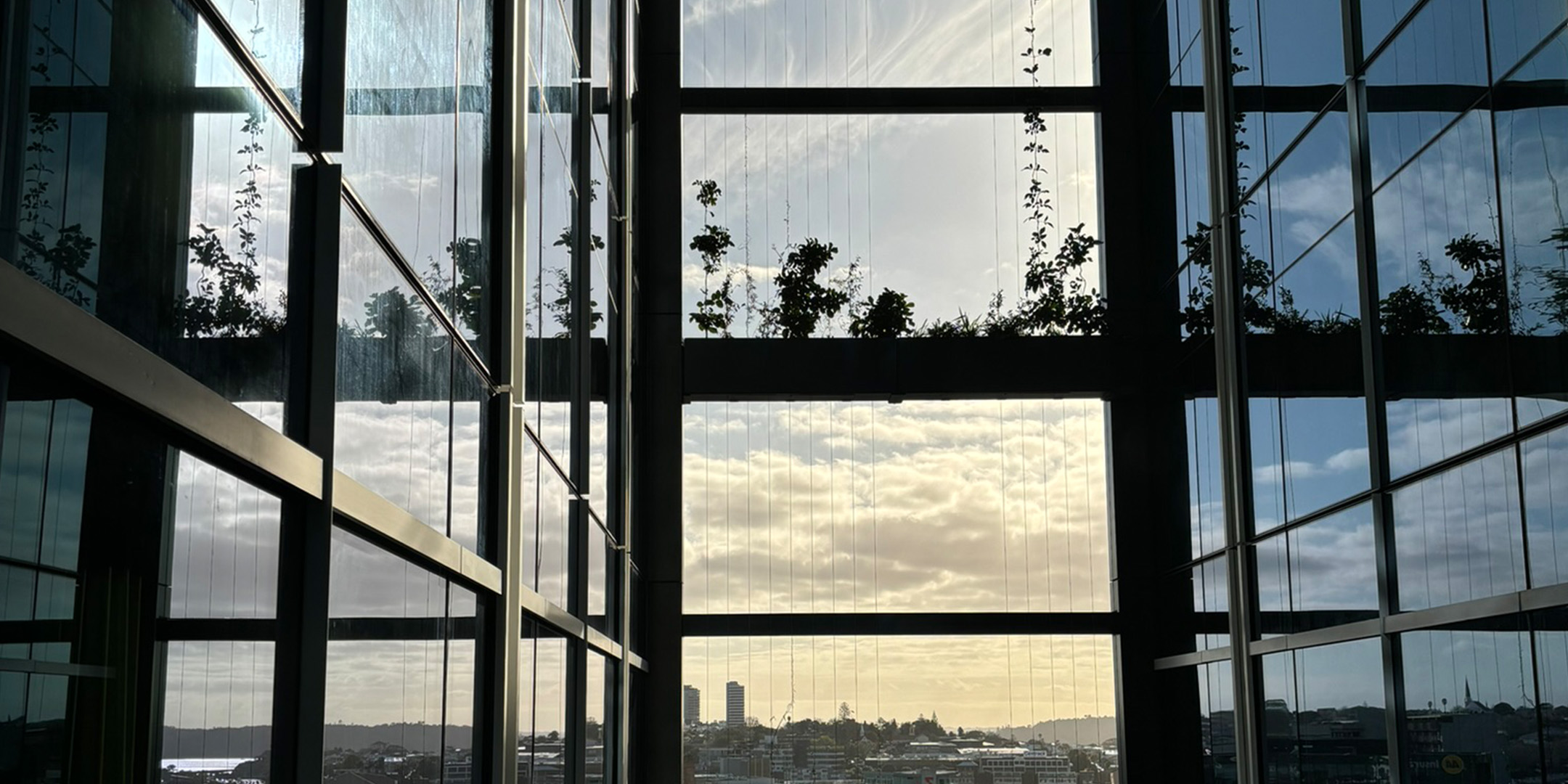
- a tensile greening system rising up the western façade and internal void.
So, I would describe the final result as an “urban green experience” designed to create a calm retreat from the city, using vertical green systems to solve limited space and limited sunlight.
Insight: Don’t design a stand-alone feature. Design an urban ecology of moments. At Hotel Grand Chancellor, it’s arrival, pause, outlook, retreat – and we integrated vertical systems to each.

Species selection isn’t decorative. It’s survival strategy
People often underestimate just how site-specific vertical planting becomes. Aspect, wind, shade, media depth, reflected heat: all of these variables intensify when plants leave the ground. That’s why species selection matters, and why system selection matters just as much.
Federal Street worked because it matched species and system to a challenging context – it’s a really shady side of the street – and because the ongoing care was not an afterthought. It was treated as part of the entire project, and there was a plan for going forward.
At Hotel Grand Chancellor, the planting palette was calibrated to shade, wind exposure and constrained substrates, with a restrained selection for resilience and long-term performance.
One thing we changed after earlier experiences was moving away from a single-species mindset. Rather than that approach, we requested the planting contractor to mix them up during installation; so if one plant or species failed, something else might take over.
That’s not just a planting idea or aesthetics. It’s risk management.
Insight: If you want a vertical landscape to read as consistently “green” over time, design for change and failure. Build redundancy into the palette.

The make-or-break factor: accountability across the whole package
The biggest lesson we’ve learned over a number of projects is this: vertical landscapes collapse when responsibility is fragmented.
From our experience, a clear plan for on-going maintenance has to be understood from the beginning, during installation, and beyond. That plan should include waterproofing, drainage, planting media, irrigation, access, and replacement strategy.
The vision may be strong, the design intent may be clear – but if delivery is broken into multiple scopes, critical gaps appear. And if it’s unclear whose job is what, then it’s easy for these problems to remain unaddressed. So leaking planters, soil loss, staining, irrigation turned off, and subsequent plant loss becomes an expensive spiral that undermines confidence in vertical systems.
At Hotel Grand Chancellor, the building-mounted planters and systems were executed with detailed design and coordination around structure, irrigation and drainage access, with concealed services and planned maintenance access.
Just as importantly, a single specialist subcontractor manufactured and installed key elements and maintained them. That created continuity of care and strong incentives to get the soil media and waterproofing right.
Insight: The delivery model is part of the design. If you don’t define accountability early, you’re designing risk into the system.
Coordination is where landscape architecture proves its value
There’s a tension in the market right now: specialist contractors can offer design-build packages, and they play a crucial role. But if the project becomes only a contractor-led product, you can lose the broader site vision and integration.
That’s why I believe landscape architects are in the right place to coordinate those elements – from irrigation and drainage to structure and aesthetics – because vertical landscapes don’t sit neatly inside a single operation.
Successful urban greenery and vertical gardens have got all sorts of aspects that we need to look at right form the concept design stage: irrigation and drainage, structural integrity, the look and feel, and how that is fitting into existing building features or new building features.
And importantly, we help protect the client’s aspiration: we can assist the client to make their vision is successfully realised at the end of the project, and also support the clients to make sure that sort of element will survive long term.
Insight: The design of vertical landscapes is often less about inventing the system and more about coordinating integration: so that what gets built is feasible, legible, and maintainable.

A practical checklist: what I believe is non-negotiable
Based on our project experience, this is what’s needed to create a vertical landscape that is set up to succeed:
- A site-driven concept that uses vertical surfaces because horizontal space is genuinely constrained.
- System + species matched to microclimate: shade, wind, aspect, media depth.
- An integrated family of typologies, not a one-off gesture
- Clear responsibility across waterproofing, drainage, irrigation, planting and maintenance.
- Maintenance designed in from the start: including access, replacement strategy, and realistic operational commitments.
Build for the long game
Vertical urban landscapes can be transformative visually, experientially, and environmentally. But their success depends on how seriously we treat them as living infrastructure.
When we get the fundamentals right – context, coordination, accountability, and care – vertical greening becomes more than decoration. It becomes a way to “green the city” in places where traditional landscape simply can’t fit.