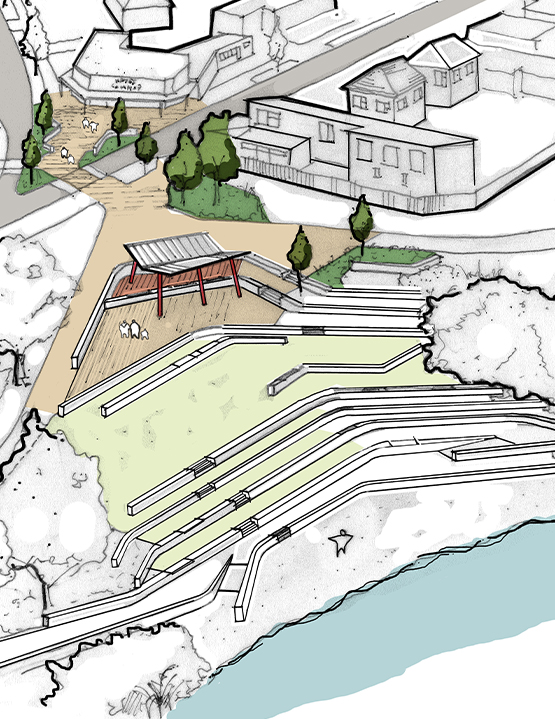
Boffa Miskell led the landscape design to transform the site into a welcoming riverside public space that balances ecological response, cultural values, and everyday use. A shaded BBQ area and a series of terraced seating spaces provide places to pause, connect, and unwind. Steps and ramps have been carefully integrated to connect higher and lower terraces, linking seamlessly with the River Ride & Walk path.
Garden terraces address the steep topography of the site, incorporating layered planting to soften the reserve and support seating areas. Complementary planting, street furniture, and signage reinforce the overall landscape character and improve legibility throughout the space. Upgrades, including a repainted toilet block, drinking fountain, and BBQ facilities, have enhanced the reserve’s functionality for local residents and visitors using the River Ride & Walk.
Graphic material was developed throughout the design process to support engagement, and the realigned, accessible River Ride & Walk promenade along the upper river terraces strengthens connections back to Jellicoe Drive and its popular café.
Some of the key design principles included:
- Collaborative design workshops – working closely with Te Haa o te Whenua o Kirikiriroa throughout design development.
- Indigenous flora – selecting species reflective of ignimbrite cliffs, sandy‑pumice river terraces, springs, and seep environments.
- Water‑sensitive design – incorporating rain gardens to capture stormwater from the toilet block roof and paved areas.
- Solar lighting – ensuring lighting is available when needed, dimmed where possible, and turned off when not required.
- Work in the riverbed – consultation with Te Haa o te Whenua o Kirikiriroa and Biosecurity New Zealand for any river works, particularly to prevent the spread of the Asian gold clam.
Boffa Miskell's planning team advised the Council on planning requirements for the proposal; and worked alongside the project team. The resource consent applications to both Hamilton City Council and Waikato Regional Council were prepared in a short timeframe. The outcome of the process was a positive, non-notified resource consent decision.
The redeveloped space now offers a welcoming space to view and engage with the Waikato River.