Beyond the bloom: Russell lupins in the Mackenzie Basin
21 October 2026
Written by Morgan Tracy-Mines
SHARE


Russell lupins have become a beloved landscape symbol, but their spread threatens indigenous habitats in the Mackenzie Basin says Morgan Tracy-Mines, a terrestrial ecologist in the Christchurch office who specialises in indigenous Mackenzie Basin botany.
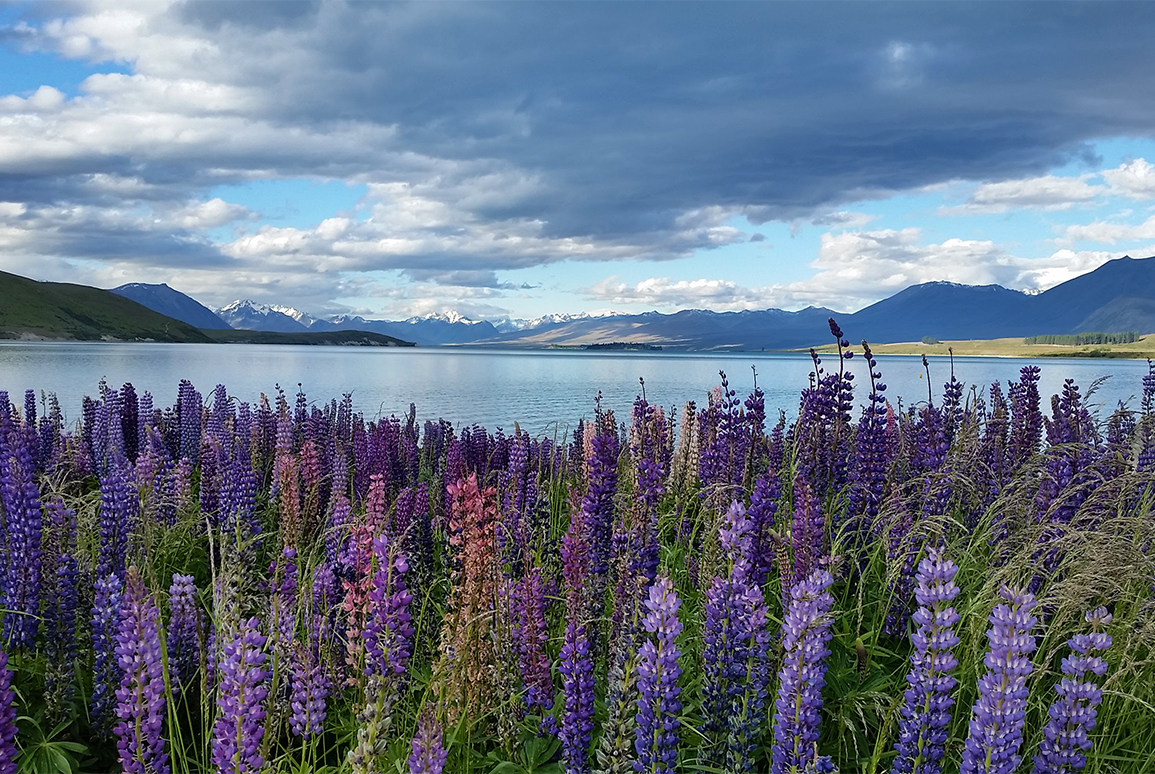
Purple and pink flowers, turquoise water and snow-covered mountains: Russell lupins have become shorthand for the Mackenzie Basin in bloom. Each spring and early summer, visitors gather around Lake Tekapo to photograph a scene widely celebrated as quintessentially New Zealand. Yet the flowers at the centre of the image are introduced plants, not indigenous flora. Their appeal presents a conservation challenge: how do we build support for controlling a weed that people have come to love?
In 1949 lupin seeds were scattered along Mackenzie roadsides to add colour to the landscape. Russell lupins have also been valued as a hardy, perennial sheep forage in the high country. But the qualities that make them useful in pasture, such as vigorous growth and persistence in difficult conditions, also help make them a troublesome invader outside it.
Across braided riverbeds, lakeshores and other open ground, dense stands of lupins can shade and displace smaller indigenous plants. What looks like an empty patch of gravel may be habitat for native species adapted to open, sparsely vegetated conditions. Adding a colourful canopy does not enrich that habitat; it changes it.
For braided-river birds, the consequences extend beyond competition for space. Lupins occupy open gravel used for nesting and provide cover for introduced predators. Their roots also stabilise river gravels, altering the shifting channels and shallow feeding areas on which birds such as wrybill depend. For birds already under pressure, the loss and modification of these habitats is a serious concern.
So why do lupins remain so conspicuous? Their persistence is partly biological. Plants regrow from their rootstock, produce abundant seeds and spread through bursting seed pods, water, and soil movement. Seeds can remain dormant in the soil for years, allowing new plants to emerge after established plants have been removed. Human activity can also spread them, deliberately by scattering seed or inadvertently by moving seed-contaminated material. Control is therefore an ongoing task, not a one-off clearance.
Their continued presence does not mean that nothing is being done. Environment Canterbury classifies wild russell lupin as a pest under its sustained control programme, with control requirements applying to rurally zoned land near waterways and property boundaries. The approach aims to reduce impacts and spread, rather than eradicating lupins everywhere. That distinction helps explain why flowering stands can remain visible even while control work continues.
Public perception adds another layer. Lupins feature prominently in images promoting the Mackenzie Basin, reinforcing their place in the landscape’s visual identity. Lupins are used in marketing for New Zealand skincare, clothing brands, and tourism. Their seeds are still sold in gift shops throughout the Mackenzie Basin. When a familiar view is treated as part of what makes a place special, removing its most colourful feature can look like damage rather than restoration. The flowers are immediately visible; the ecological cost is much less obvious. A patch of bare gravel may look unremarkable in a photograph, even when it provides habitat that a bank of lupins cannot.
This is not simply a contest between people who appreciate beauty and people who understand ecology. Lupins can be beautiful and ecologically damaging at the same time. Making that distinction clear is central to building support for control. The challenge is to help people see what lies beyond the bloom: the indigenous plants, open nesting grounds and shifting river channels that make the Mackenzie Basin distinctive. The landscape does not need to be covered in colourful flowers to be full of life.


