Spatial Planning: are we ready to turn ambition into action?
1 September 2026
Written by Jaimee Cannon and Stephanie Styles
SHARE


Spatial planning gives us the means to look beyond individual sites, projects and statutory processes, and take a longer-term view of the future of our regions. Doing so will require new ways of working, systems thinking, stronger collaboration, and a broader perspective.

There is broad recognition that spatial planning has an important role to play in shaping the future of our regions.
The idea is compelling: bring people together around a shared understanding of where a region is heading, where growth and change should occur, what infrastructure will be needed, and how environmental, cultural, social and economic priorities can be considered together, and effectively implemented.
But as those of us involved in preparing Regional Spatial Plans – including councils, iwi, planners, infrastructure providers and technical specialists – move from the concept of spatial planning towards delivering Regional Spatial Plans (RSPs), two key fundamental questions are emerging:
Are we ready to do it?
Does the framework provide enough time to do it properly?
These fundamental questions were some of the strongest messages from spatial planning workshops held around Aotearoa. The conversations were not characterised by resistance to spatial planning. Quite the opposite. There was a strong appetite to make it work, but there was also a healthy realism about what will be required.
Many raised concerns that the requirement to prepare and notify spatial plans within 21 months of Royal Assent of the Planning Act, and nine months of receiving national direction, is going to be incredibly tight; and questioned whether this provides enough time to do it properly.
Across the workshops, six recurring themes came through. Together, they suggest that the success of spatial planning will depend on more than getting the legislative framework right. It will depend on whether we create the conditions for regions to work differently; with sufficient clarity, capacity, leadership, evidence and, ultimately, the means to turn strategy into action. This think-piece describes those key themes and implications for turning spatial planning ambition into action.
1. Clarity first
Perhaps the strongest message was simple: regions want to know what is expected of them.
There were repeated calls for early and clear national guidance on Regional Spatial Plan (RSP) content and process, templates, terminology, core obligations, data standards and expectations from the Ministry for Cities, Environment, Regions and Transport (MCERT).
There is a balance to strike. Too much prescription could undermine the regional responsiveness that spatial planning is intended to enable. Too little direction risks every region reinventing the wheel, and consuming scarce resources on approaches that could be standardised nationally. The challenge may be to provide clear national standards while leaving room for regional ambition and difference.
The earlier that clarity arrives, the more confidently regions can get moving.
2. Capacity is not an implementation detail
Developing an RSP is not simply another piece of planning work that can be added to an already full programme. It requires sustained strategic thinking, technical expertise, engagement, governance support, project management and coordination across multiple organisations, and different stakeholders within organisations too. It is not just councils that need capacity. Iwi and Māori partners, central government agencies, infrastructure providers, development sector representatives, and the wider planning profession will all be critical.
There is a risk that we underestimate this because spatial planning is a long-term exercise, but long-term outcomes require short-term investment.
Regions are expected to develop high-quality, evidence-based plans, within 21 months from September 2026, while continuing business as usual. Therefore, resourcing RSP development needs to be treated as a system investment, not simply a council project cost. There remains significant concern within local government as to how the development and implementation of the RSPs will be funded. It is critical that resourcing and funding to support the RSP process is confirmed as soon as possible. In addition, it is clear that there will need to be a significant mindset shift from the traditional model of governance.
3. The governance challenge may be harder than the planning challenge
Spatial planning requires collaboration across Council boundaries within each Region.
Councils have different priorities, communities have different aspirations, iwi and hapū have different relationships with place, and central government agencies bring national priorities and investment decisions. The Spatial Plan Committee model creates an opportunity to bring these perspectives together. But good governance will not happen automatically because a governance structure already exists and it is clear that a new approach is needed to tackle these new challenges.
There will be a need for capable elected members, clear roles, strong programme management, effective council relationships, and genuine leadership. Many of the issues RSPs are intended to address – housing, transport, infrastructure, economic development and environmental pressures – also cross regional boundaries.
The depth of the relationships may ultimately matter as much as the quality of the plan. It will be important to invest in relationship-building early: getting the foundations in place now to ensure that the plan is robust, and that implementation is achievable.
4. A plan is only as good as what it delivers
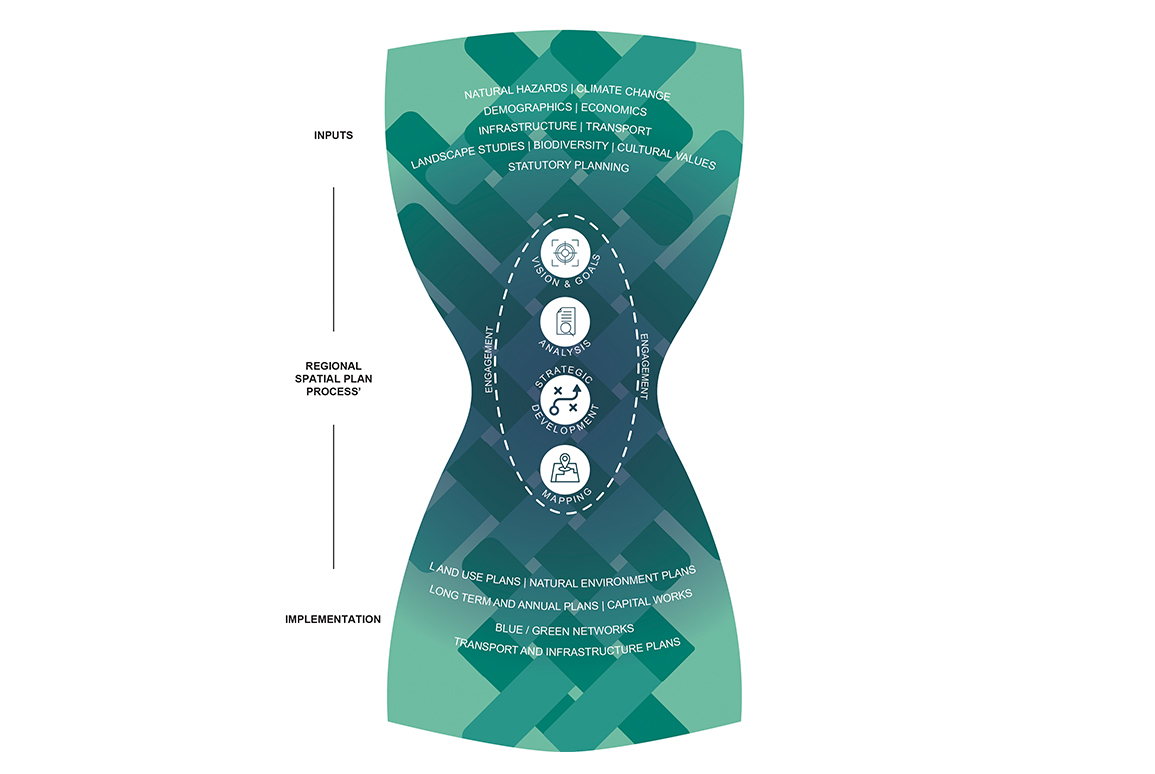
Perhaps the most important test of RSPs will be what happens after they are adopted. Implementation is everything.
There was repeated concern about whether RSPs will actually influence infrastructure delivery, Long-Term Plans, implementation plans, government agency priorities, regional deals, funding mechanisms and other investment decisions to ensure that promises are kept by both public and private agencies.
If an RSP becomes another strategy sitting on a shelf, it will have failed its fundamental purpose.
A successful RSP should help answer practical questions:
- Where should growth and other changes occur?
- What infrastructure needs to be delivered, by when, and who pays?
- Where should investment be prioritised?
- What environmental constraints or opportunities should shape development? and
- Who is responsible for making it happen?
Implementation cannot be an afterthought. The machinery for delivering the spatial plan needs to be considered from the beginning and woven into the Spatial Plan. The Implementation Plan should clearly identify actions and responsibilities to effectively deliver the plan and enable partnerships and external funding arrangements where this is necessary to ensure success.
An RSP should not simply describe the future a region wants. It needs to help create the machinery for delivering it.
5. Staying strategic is harder than it sounds
There was also a strong message about maintaining a genuine regional perspective.
Regions contain communities with very different experiences, pressures and aspirations. There will inevitably be competing views about where growth should occur, what infrastructure should be prioritised and which environmental, social, cultural and economic outcomes matter most. The temptation will be to resolve these issues at a local level or revert to details that are best addressed in statutory land-use plans.
But an RSP cannot – and should not – become a collection of local planning exercises.
Its value lies in identifying the issues that are genuinely regional, understanding how they interact, and making strategic choices about the direction of the region as a whole over the longer term.
That requires a broad lens: growth, change and/or development alongside rural land, freshwater, biodiversity, the coast and marine environment, infrastructure, economic development, social outcomes and cultural values. An RSP should also contemplate other forms of regionally significant change that may not always manifest as growth per se; for example, economic, social and transport resilience, rural-urban shifts, changes in productive industries, declining populations, birth rates and other social dynamics may be critical considerations not directly associated with "growth" in the traditional sense.
The art will be knowing what belongs at the regional scale – and being disciplined enough to leave the rest to other planning processes.
6. We cannot make strategic decisions without understanding uncertainty
The final recurring theme was data and evidence.
Spatial planning depends on a shared understanding of a region: its population, economy, infrastructure, natural environment, hazards, land use, communities and future pressures. But different organisations often hold different datasets, assumptions and levels of confidence in the evidence available. Questions around data consistency, data sovereignty, evidence standards, assumptions and transparency therefore become particularly important.
There is an opportunity here for RSPs to create a much stronger shared evidence base – one that supports not only the plan itself, but future planning, investment, and decision-making. We should also be comfortable with uncertainty. Strategic planning is about making decisions about a future that cannot be predicted with certainty.
The important thing is to be transparent about what we know, what we do not know, what assumptions we are making, and how uncertainty affects the choices being made.
So, are we ready?
The workshops revealed a more nuanced picture. There is clearly a willingness to embrace spatial planning. There is also considerable expertise, experience and enthusiasm across the motū.
However, the workshops have highlighted real challenges: the need for clearer national direction, greater capacity and resourcing, more time to do it properly, strong governance, better evidence, genuine collaboration and, most critically, a stronger connection between strategy and implementation.
There are undoubtedly challenges ahead, but they should not overshadow the opportunity. We can build a spatial planning system that is practical, collaborative and genuinely capable of shaping better regional outcomes.
That is what makes this such an exciting time for planners and those operating in the wider planning system to influence change and growth. Regional Spatial Plans give us an opportunity to step beyond the traditional boundaries of statutory planning and think much more fundamentally about how our regions function and where they are heading.
We get to ask the big questions:
- Where and how should our communities grow and change?
- What infrastructure will they need?
- How do we protect the things that make our regions special?
- How do we respond to climate change and natural hazards?
- How do we support productive rural land, thriving communities and resilient economies?
- How do we give effect to the aspirations of iwi and Māori?
- How do we make decisions today that will still make sense decades from now?
These are not easy questions. But they are exactly the questions that strategic planning should be answering.
Spatial planning gives us the means to look beyond individual sites, projects and statutory processes, and take a longer-term view of the future of our regions. Doing so will require new ways of working, systems thinking, stronger collaboration, and a broader perspective.
The challenge is not simply to prepare for change, but to embrace the opportunity to help shape it.

This analysis has been prepared by Stephanie Styles and Jaimee Cannon, co-presenters of the NZPI: Foundations for Spatial Planning workshop series presented across Aotearoa in July and August 2026, with input from Dave Moule and Ken Gimblett.
Related Articles
Mapped In or Locked Out? The Developer’s Stake in Regional Spatial Planning
21 September 2026

Delivering a robust Spatial Plan: inputs, opportunities and constraints
27 November 2025

You Need to Know: the Spatial Planning process
23 November 2025

From Vision to Action: delivering on a regional spatial plan
10 March 2026